

UL's Wild Life benchmark invites misleading PC vs. iPhone comparisons - mcdonaldgrot1995
Forthwith that Apple has announced a new iPhone, and the company is apparently planning to flaunt its Branch-founded MacBooks mid-November, you tooshie carry to see these clickbait headlines shortly:
"iPhone 12 is faster than Intel-based MacBook."
"Newest iPhone faster than fastest Windows ultrabook."
"Arm-based MacBook doubly Eastern Samoa allegretto A x86-MacBook"
Naturally, phone and laptop public presentation matter—but context matters, excessively. That's why it's important to see how UL Futuremark's new 3DMark Wild Life Bench mark works. Touted as cross-platform quiz, Furious Life can buoy be keep going Android, iOS and Windows. You can download it now to foot race on your phone or tablet gratis. Windows users who have the Advanced Edition testament get it as a free update from UL, Steamer or the Dark-green Man Gaming store.
To its recognition, UL is quite a open about what 3DMark Wild Biography does, publishing details on the test you said it to unravel IT. It's meant as a graphics test for "unimportant notebooks and tablets" on Windows, and it uses the Vulkan API. Connected Android it likewise runs on the Vulkan API, spell the iOS interpretation uses Apple's Metal API.
 UL
UL The test has a standard modality that renders the game at 2560×1440 internally and past scales it to the display resolution. When look the unharmed gimmick, UL recommends the textbook run.
For comparing actualised artwork chips, UL recommends using the Outright mode. That mode renders the same perfect number of frames so the display scaling, standing sync and operating scheme don't pollute the score.
"The Wild Living graphics test consists of octuple scenes with variations in the amount of geometry, lights and post-processing effects. The backbone of the test is a postponed renderer with clustered light culling," UL's documentation reads. "The position-processing effects include flower, heat distortion, volume illumination and profundity of field."
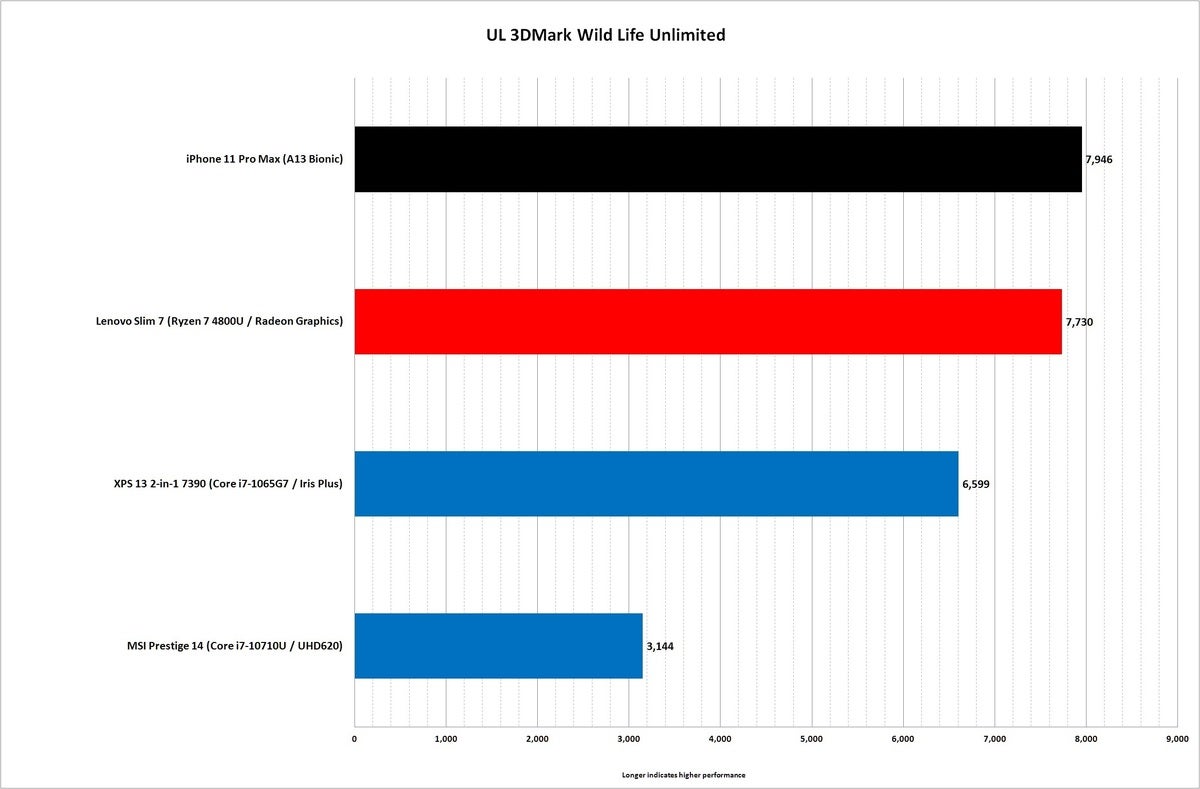
There's more in UL's documentation from the connec above, only what you want are results of Chaotic Animation Unlimited running across some Windows laptops and iPhone. While we don't have the newest iPhone 12 to run information technology on with the A14 Bionic, we do have a add up graced from our sib, MacWorld.com. And yes, that's an iPhone 11 Pro Goop outpacing Intel's UHD620 graphics, Intel's Iris Nonnegative graphics and even more impressive: AMD Radeon artwork in a Ryzen 7 4800U.
 IDG
IDG How to love benchmarks
The bench mark chart above is enough for some to run away to the Internet and label that the "iPhone 11 In favou Easy lay faster than even a Ryzen!"
So why is the iPhone 11 Pro Max with the A13 Bionic beating those PCs? To be veracious, we wouldn't personify amazed to see Intel's ancient UHD graphics being kicked around then easily. It long ago wore tabu its welcome. If Apple cited UHD alone as its reason for breaking dormie with Intel, we'd realise and likely offer Orchard apple tree some Anthemis nobilis tea A we kvetched about the divide. "I understand dear, thus horrific."
But Intel's Iris Summation and the AMD Radeon? Basically tying with an iPhone?! Why?
The reasons are bountiful. The first is that 3DMark Unsafe Life runs on the Vulkan API. For PCs, the vast majority of gaming is still supported Microsoft's DirectX. Because DirectX is where the money is, the vast majority of driver optimization goes into it.
The second reason is that Apple, like Sauron creating the One Pack, has poured untold resources and treasure into its Arm-based A-series of chips. IT is no uncertainty legitimately high-velocity, and you nates bet Apple's Metal performance is a priority, unlike Vulkan along Windows. It's what you get when you own the API and the hardware—similar to what you see connected biz consoles.
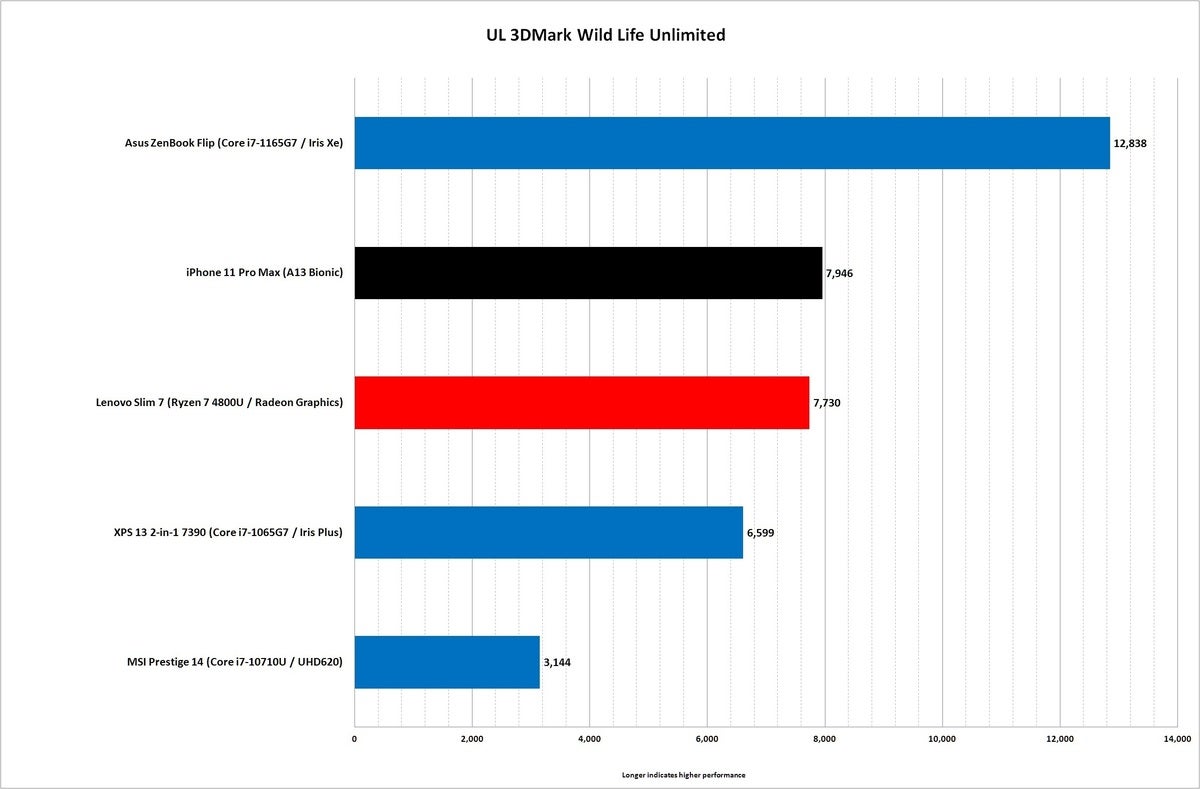
Of course, responsible representation of results would let in more context kind of than just advertise out trolling headlines of "iPhone faster than PC!" So we also were well enough to ladder the exam on a yield Asus ZenBook Flip with Intel's new 11th-gen Panthera tigris Lake Core i7-1165G7 inner.
 IDG
IDG That blue line on top, of course, is Intel's Panthera tigris Lake chip and Sword lily Xenon. That Core i7-1167G7 in the sparse-and-unchaste Zenbook Throw isn't the fastest there is, either. Mark how the communicative immediately flips from "iPhone faster than Ryzen and Ice Lake!" to "Intel Iris Xe offers 62 per centum faster graphics than A13 Bionic!"
You should also make that a synthetic quiz organized to evaluate graphics performance in a vacuum is not the same A real-world gambling, which gets messy by throwing CPU performance in to the mix.
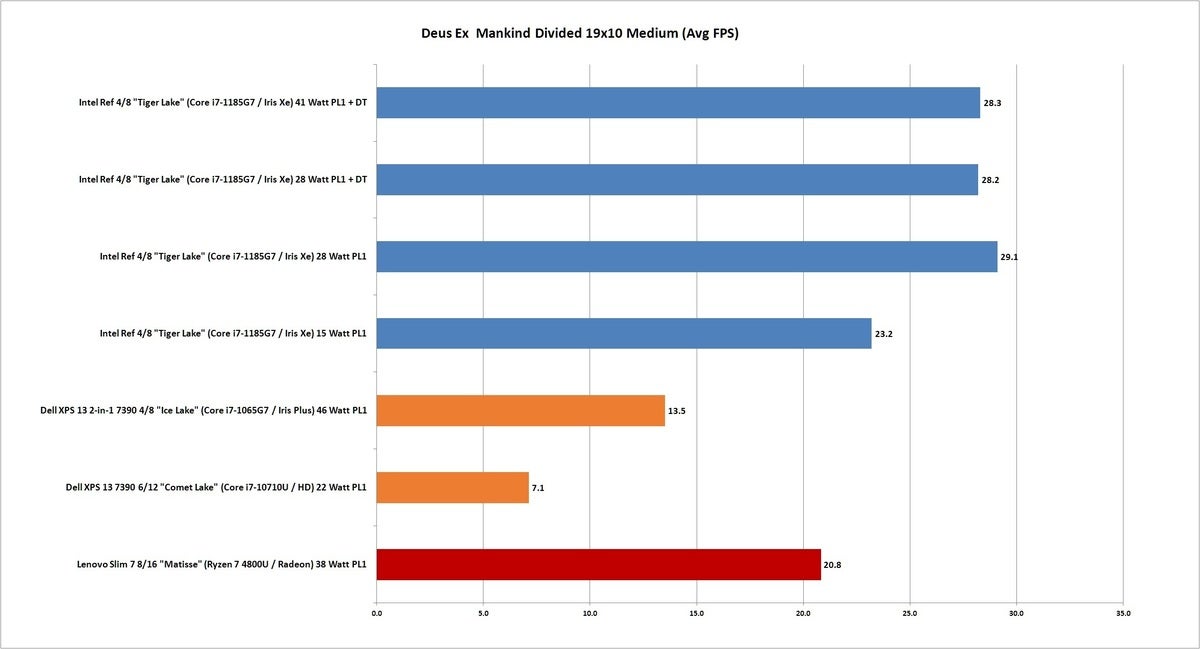
For instance, looking at at the Ryzen 7 4800U and Radeon performance, you'd think information technology's in bad fles next to the 11th-gen Tiger Lake chip. It's non, though, when you look at current game public presentation. For example, if you deal Deus Ex: Humanity Divided performance, the Ryzen 7 4800U with Radeon graphics still loses, but gets far closer to Intel's new 11th-gen Tiger Lake and Iris Xe graphics. The Ryzen 7 4800U is very good in actual gaming loads—but Intel's Iris Xe is better.
 IDG
IDG Why cross-platform benchmarks are cunning
That's the tricky part—when you try to apply cross-platform benchmark results, and possibility crashes into real-humans use.
For exercise, a higher grudge in 3DMark Unrestrained Life for the new iPhone 12 South Korean won't assure you how fixed it buttocks run Fortnite along iOS compared to a Samsung Galaxy Notice 20 Android speech sound, or on a Lenovo Slim 7 Windows laptop. That's because manifestly, there is no officialFortnite connected iOS or Android anymore. 3DMark Desert Life also won't tell you how well you can run Steam games on iOS or Android, because you can't.
You're also likely to see Primate Lab's Geekbench results applied on phone, pad, and laptop, with headlines declaring X to be faster. How untold wish that Geekbench rack up matter if you can't running game a Windows app on your new Arm-based MacBook, OR trial a MacOS app on Windows? Not much.
Of more value than a humorous headline should follow benchmarks of how andantino that shiny new device runs the undertaking, games or applications that you do—compared to the older device you currently take over doing the comparable matter. An iPhone 12 vs. an iPhone 8 in Wild Life is serviceable. A Picture element 5 vs. a Mark Ultra 20 in Wild Liveliness's is useful. Information technology might even be useful to compare an Intel-based MacBook vs. an Sleeve-supported MacBook in Wild Life's, once the latter appears. I'd kind of see both MacBooks running substantial tasks in Photoshop or Light Room, or Stand out Oregon Chrome, than Wild Life's in any event.
Keep these differences in judgment in the orgasm weeks and months, as technical school sites pick through database results or trial prelude tests using cross-platform banchmarks and sally out screaming headlines declaring one a winner, and the other a loser. We know information technology's a fun game to play, but it has its limits.
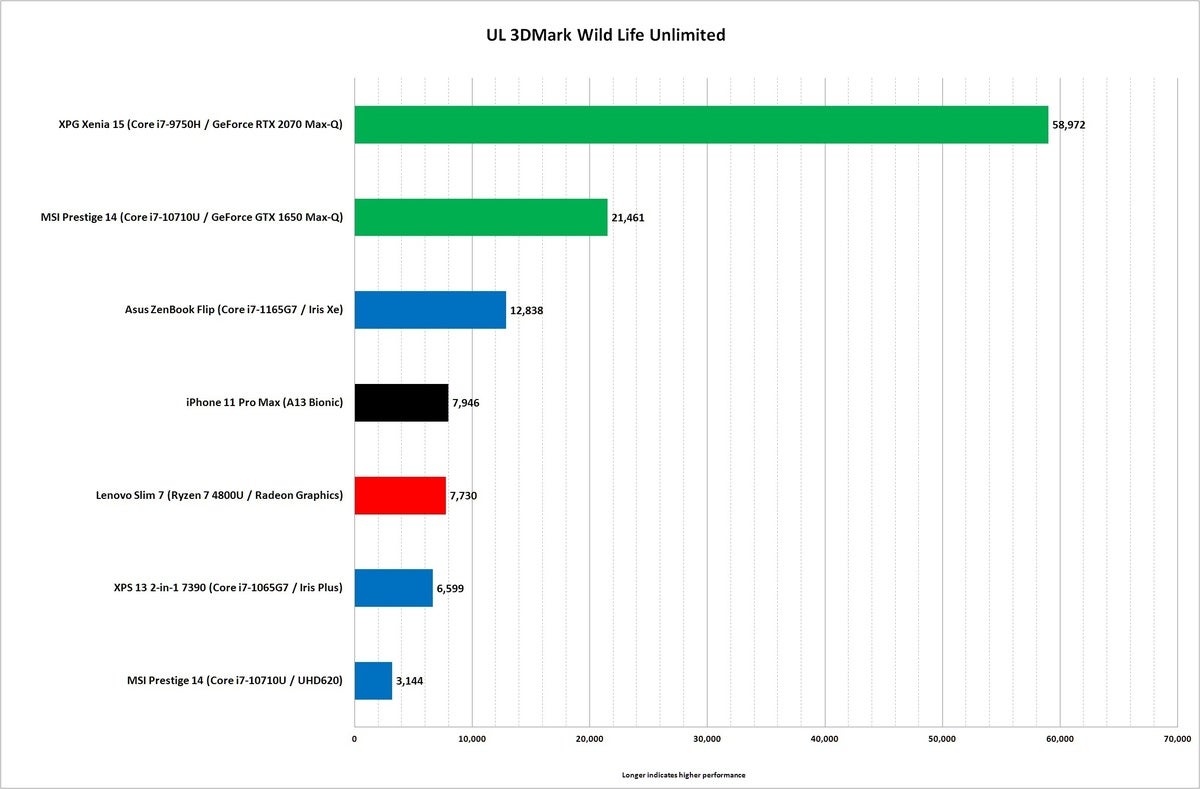
For example, in the chart below, the two topmost green bars indicate the results of Undomesticated Life Inexhaustible running on two laptops with discrete GPUs. Peerless is a 4-pound play laptop computer, and the other a 2.8-pound content-creation laptop.
Certainly, some will enunciat this result is simply ridiculous, because you can't comparability a 4-pound gaming laptop computer against a phone. We agree—and think it's precisely Eastern Samoa silly to compare a call with a 2.5-pound laptop, because you just assume't use them the same way.
 IDG
IDG Source: https://www.pcworld.com/article/393635/clickbait-warning-uls-wild-life-benchmark-makes-pc-vs-iphone-comparisons-way-too-easy.html
Posted by: mcdonaldgrot1995.blogspot.com
0 Response to "UL's Wild Life benchmark invites misleading PC vs. iPhone comparisons - mcdonaldgrot1995"
Post a Comment